Table of Contents
- 1. When Is a Lithium Polymer Battery the Right Choice?
- 2. Start with Voltage and 1S, 2S or 4S Configuration
- 3. Define the LiPo Battery Size Envelope First
- 4. Match Capacity, Runtime and Load Current
- 5. Specify PCM/BMS, NTC, Leads and Connectors
- 6. Information to Provide for a Fast, Accurate Quote
- 7. Compare Relevant ASOL Lithium Polymer Battery Packs
- 8. Frequently Asked Questions
A custom lithium polymer battery is not selected by capacity alone. The right pack has to fit the device enclosure, provide the required voltage and peak current, remain safe in the intended environment, and connect cleanly to the product electronics. This guide helps product teams turn those requirements into a clear custom LiPo battery pack specification.
Whether you need a thin rechargeable battery for a handheld device, a compact multi-cell pack for portable equipment, or an OEM battery assembly with protection and a custom connector, the most efficient project starts with the electrical and mechanical constraints together.
1. When Is a Lithium Polymer Battery the Right Choice?
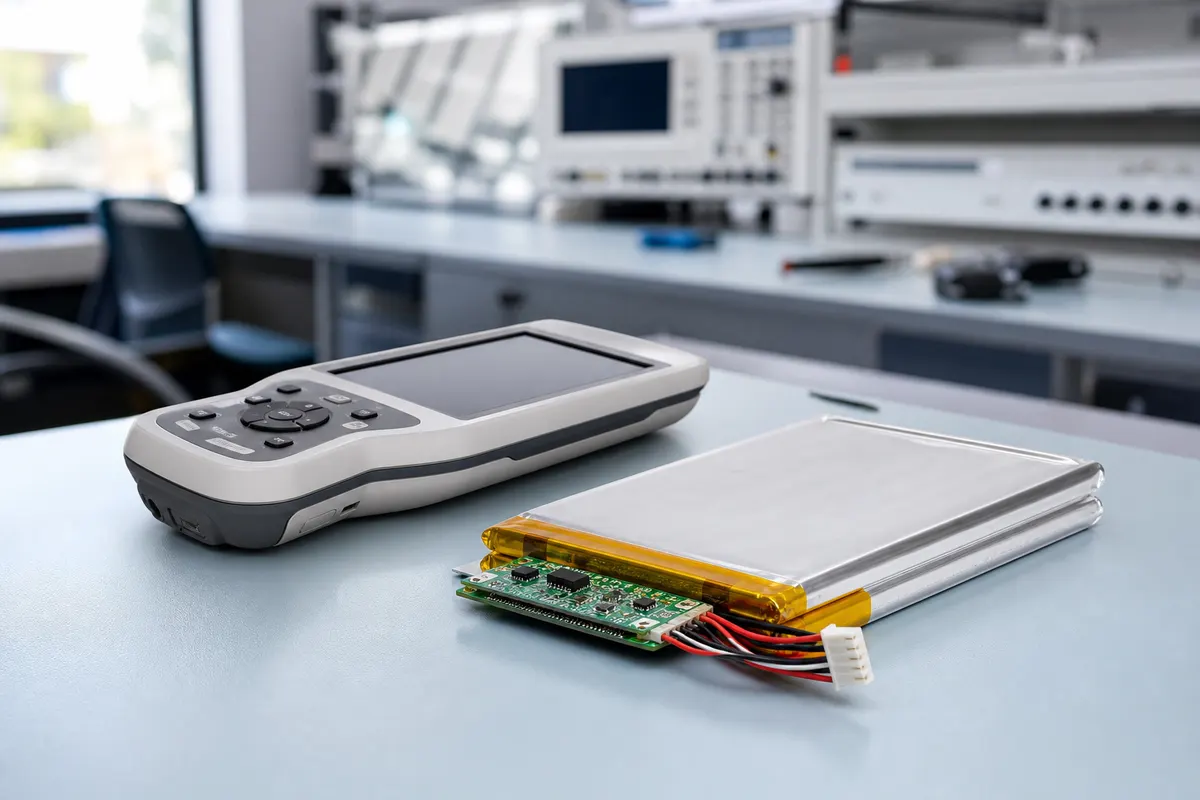
Lithium polymer pouch cells are especially useful when a standard cylindrical cell wastes too much space or cannot follow the shape of the product. A LiPo pouch cell offers a low-profile form factor, a broad range of thickness and footprint options, and practical flexibility for custom leads, PCM protection and pack wrapping.
Consider a custom lithium polymer battery when your device needs:
- A thin rechargeable battery that fits behind a display, inside a wearable, or within a shallow enclosure.
- A defined thickness × width × length envelope rather than a round-cell compartment.
- Custom voltage, capacity, connector, wire length or protection behavior.
- Stable discharge performance for wireless, medical, handheld, smart-home or portable industrial equipment.
For available cells and packs, start with ASOL’s lithium polymer battery category and then narrow the configuration with the project requirements below.
2. Start with Voltage and 1S, 2S or 4S Configuration
Voltage is normally determined by the electronics, motor, charger and input range of the device. LiPo cells have a nominal voltage of about 3.7V per cell. Cells are connected in series to increase voltage, while parallel strings are used when more capacity or current capability is required.
| Typical configuration | Nominal voltage | Common use |
|---|---|---|
| 1S | 3.7V | Thin rechargeable batteries, compact consumer devices and small wireless products |
| 2S | 7.4V | Portable electronics, instruments and medium-power devices |
| 4S | 14.8V | Higher-voltage portable equipment and custom power assemblies |
Do not select a higher series count simply to obtain more energy. A series connection changes the charging method, protection thresholds and wiring requirements. Confirm the device’s acceptable voltage range, charger type and peak power draw before finalizing 1S, 2S or 4S architecture.
3. Define the LiPo Battery Size Envelope First
For a pouch cell, the available volume is often the primary decision point. Supply the maximum thickness × width × length available inside the final enclosure, including room for leads, protection PCB, padding and mechanical tolerances.
- Thickness: usually the hardest dimension to change after the housing is designed. Leave clearance for cell swelling allowance and protective wrapping.
- Width and length: determine the pouch-cell footprint. Identify keep-out areas, screw posts and cable routing before choosing a cell.
- Lead exit: specify the side where wires must leave the pack and the minimum bend radius needed for assembly.
- Protection board location: PCM/BMS placement can increase one local dimension even when the bare cell fits.
Sharing a drawing, 3D model, internal cavity photo or dimensional sketch is the fastest way to avoid a LiPo battery size mismatch.
4. Match Capacity, Runtime and Load Current
Capacity is measured in mAh and indicates how much charge the pack can store. Runtime depends on the actual average device current, not just the label capacity. A practical first estimate is:
Estimated runtime (hours) = usable capacity (mAh) ÷ average load current (mA).
Then check the peak load separately. Transmitters, motors, heaters, pumps and startup circuits may draw much more current than the average. A battery that meets the runtime target can still be unsuitable if its continuous or peak discharge rating is too low.
- Provide average current, continuous current and short-duration peak current.
- State whether the device must operate at low temperature or in an enclosed, warm housing.
- Identify the minimum acceptable runtime and desired charging time.
- Allow engineering margin instead of selecting a pack at its maximum current limit.
5. Specify PCM/BMS, NTC, Leads and Connectors
A custom LiPo battery pack usually needs more than cells. The protection and interface parts should be specified early so the pack works safely with the product and production process.
- PCM or BMS: protects against over-charge, over-discharge, over-current and short circuit. The needed current rating must match the device load.
- NTC: gives the charger or host system a temperature signal when temperature-aware charging is required.
- Leads: choose wire gauge, length, color coding and exit direction based on current and assembly access.
- Connectors: specify the mating connector, pin count, keying, polarity and whether the pack needs a separate balance or temperature lead.
- Pack finish: decide on shrink wrap, insulating tape, labels, foam, brackets or a custom enclosure as needed.
6. Information to Provide for a Fast, Accurate Quote
A complete inquiry shortens sample selection and makes the quotation more accurate. Send the following information when you request a custom lithium polymer battery:
- Target voltage and preferred 1S, 2S, 4S or other series configuration.
- Maximum LiPo battery size: thickness × width × length, plus a drawing or photo where possible.
- Required capacity, expected runtime, average current and peak current.
- Charging method, protection requirements and whether an NTC is required.
- Wire length, connector model, polarity and required lead exit direction.
- Operating temperature, target quantity, sample quantity and certification or shipping requirements.
Even if some values are still open, an engineering discussion can start with the device type, installation space and electrical target. Please contact ASOL Battery with the information you have.
7. Compare Relevant ASOL Lithium Polymer Battery Packs
These two reference packs show how a change in series count changes the voltage level for different device needs:
- ASOL 103450-2S 7.4V 2000mAh LiPo battery pack: a 2S, 7.4V 2000mAh option for projects that need a compact mid-voltage pack.
- ASOL 605573-4S 14.8V 3000mAh LiPo battery pack: a 4S, 14.8V 3000mAh option for applications that need a higher-voltage LiPo battery pack.
They are reference points rather than universal replacements. A final custom LiPo battery pack should be matched to your enclosure, current demand, charging system and connector requirements.
8. Frequently Asked Questions
Should I choose a 1S, 2S or 4S LiPo battery?
Choose the series count from the device voltage and charger design. A 1S pack is typically 3.7V nominal, 2S is 7.4V and 4S is 14.8V. Confirm the full charge voltage and operating range with the electronics designer before finalizing the pack.
How do I select the right LiPo battery size?
Start with the maximum thickness, width and length available in the enclosure. Include clearance for protection circuitry, wires, wrapping and assembly tolerance instead of measuring only the empty cavity.
Do all custom LiPo battery packs need a BMS?
Small packs often use a PCM protection board, while higher-current or multi-cell packs may need a BMS with the required current, balancing and communication functions. The correct choice depends on the series count, charger and load profile.
What should I send for a quote?
Provide voltage, capacity, maximum dimensions, current profile, charging method, connector, wire requirements, operating conditions and target quantity. A drawing or installation photo is highly useful.